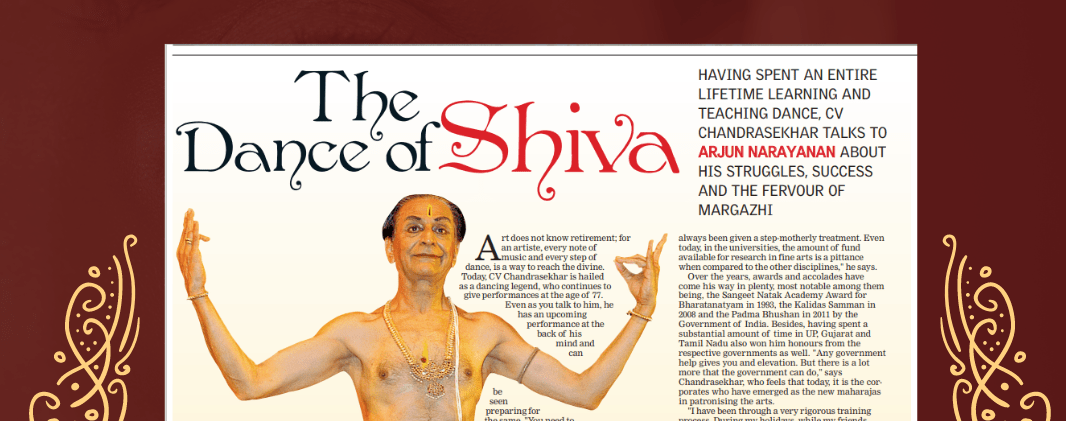
In the Margazhi of 2012, I got a chance to interview the Bharatanatyam legend CV Chandrasekhar, popularly known as CVC Sir to all in Madras. I knew his name right from childhood for I was fortunate to learn dance for a few years from his supremely talented daughter Chitra Chandrasekhar Dasarathy. Even as he spoke to me, his wife and partner on stage Jaya Chandrasekhar supplemented his responses with her candour. They had been married for 50 years then. Even as we spoke, there was a stream of visitors at his home, often comprising of young artistes who had come to invite him for their performances and seek his blessings. It was a home open to all. The below story was published on the day he attended a panel discussion at the Krishna Gana Sabha that year. CVC Sir started at a time when society’s attitude to dance was quite different from what it is today.

Art does not know retirement; for an artiste, every note of music and every step of dance, is a way to reach the divine. Today, CV Chandrasekhar is hailed as a dancing legend, who continues to give performances at the age of 77. Even as you talk to him, he has an upcoming performance at the back of his mind and can be seen preparing for the same. “You need to love your job if you want to excel. Dancing is a call from within. When a request for a performance comes your way, you cannot feel unprepared for it. An artiste has to be ready to take the plunge all the time,” he says.
Looking back at his early days, he remembers the time when the very idea of a boy dancing was scoffed at. “Learning dance was not seen in a positive light then and the society did not approve of it. But my father was very helpful and encouraged me to learn the art. Sadly, he never lived to see me succeed,” says Chandrasekhar, who did his masters in Botany in Varanasi. But dance was his real calling and his training at Kalakshetra was what would keep him in good stead in the years to come.
But then, success did not save the maestro from jibes and sarcastic remarks. As a matter of irony, a man dancing the dance of Shiva seemed to be the biggest moot point. “The so called scholars, who sat down to review, came up with headlines like Bharatanatyam by man unnatural, Skill of paradox, or worse, A mere male excels in dance! But then, all those friends and family members who teased me and dismissed me, are appreciative of my art today,” he says. Even when he taught at the MS University in Baroda, many of his colleagues could not digest the fact that a professor of dance was being paid the same amount as them. “Art has always been given a step-motherly treatment. Even today, in universities, the amount of fund available for research in fine arts is a pittance when compared to the other disciplines,” he says.
Over the years, awards and accolades have come his way in plenty, most notable among them being, the Sangeet Natak Academy Award for Bharatanatyam in 1993, the Kalidas Samman in 2008 and the Padma Bhushan in 2011 by the Government of India. Besides, having spent a substantial amount of time in UP, Gujarat and Tamil Nadu also won him honours from the respective governments as well. “Any government help gives you elevation. But there is a lot more that the government can do,” says Chandrasekhar, who feels that today, it is the corporates who have emerged as the new maharajas in patronising the arts.
“I have been through a very rigorous training process. During my holidays, while my friends went to play, my father would make it a point that I practiced dance. Then, there were no recordings to listen to, so I would sing and dance simultaneously. I think that ability is being lost today, as there is no need to retain the music,” says Chandrasekhar, who says, rather whimsically, that technology has not spoilt him. “It is not easy sometimes to fit into the fast-moving world. I had a Facebook account as well, but found it an arduous task to update it continuously and I do not have the luxury of having a person dedicated to these tasks. Today, thanks to Skype, even a person in Timbaktoo can learn Bharatanatyam. But I want learning to be a face-to-face process,” he says. Insistence on a strict learning methodology might also have meant skipping some monetary benefits. “But then, people who come under my tutelage know what I stand for. My principles are clear.”
Last week, Chandrasekhar performed in Varanasi. “I met my wife Jaya in Varanasi. This year marks 50 years of our relationship. The performance was our way of giving thanks to Lord Vishwanath and Mother Ganga,” he says. Chandrasekhar has been in Chennai for more than a decade now. “The extravaganza we see for the classical art forms during Margazhi, cannot be seen in any city in the world. But then, there still exists some sense of parochialism,” says Chandrasekhar, pointing out to the fact that even today, most people do not make any concrete effort to appreciate or understand the art traditions of the north. “People tell me that being in Delhi will bring in a lot of benefits. But I have no time for lobbying and meeting important people. Art has taught me many things. I am now glad transferring those things to my students. I have internalized dance to such an extent that today, there is nothing else that I know,” he says signing off.
This interview was published in The Times of India, Chennai, in their Margazhi special feature in 2012.
 Madraswallah
Leave a comment