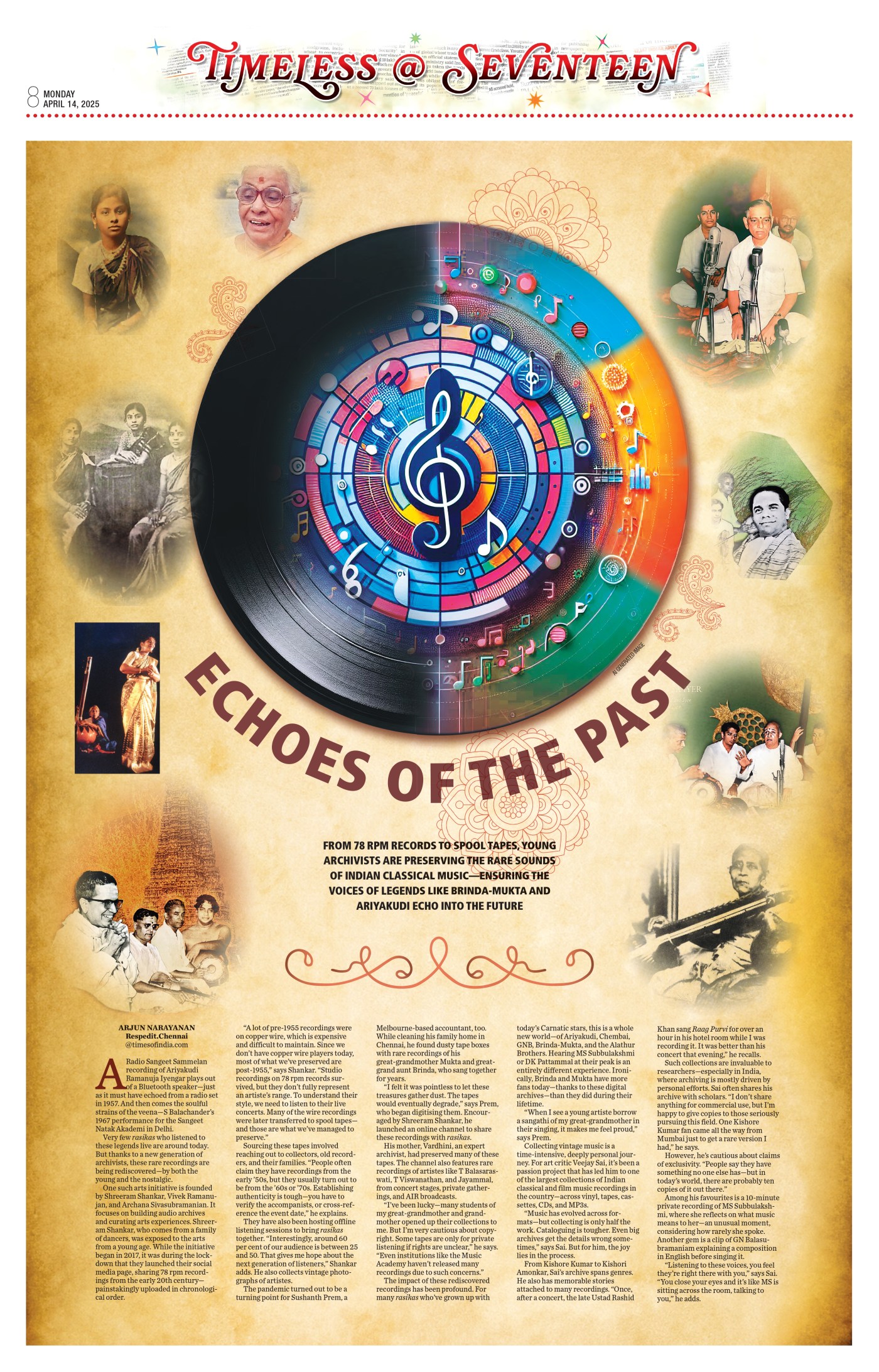
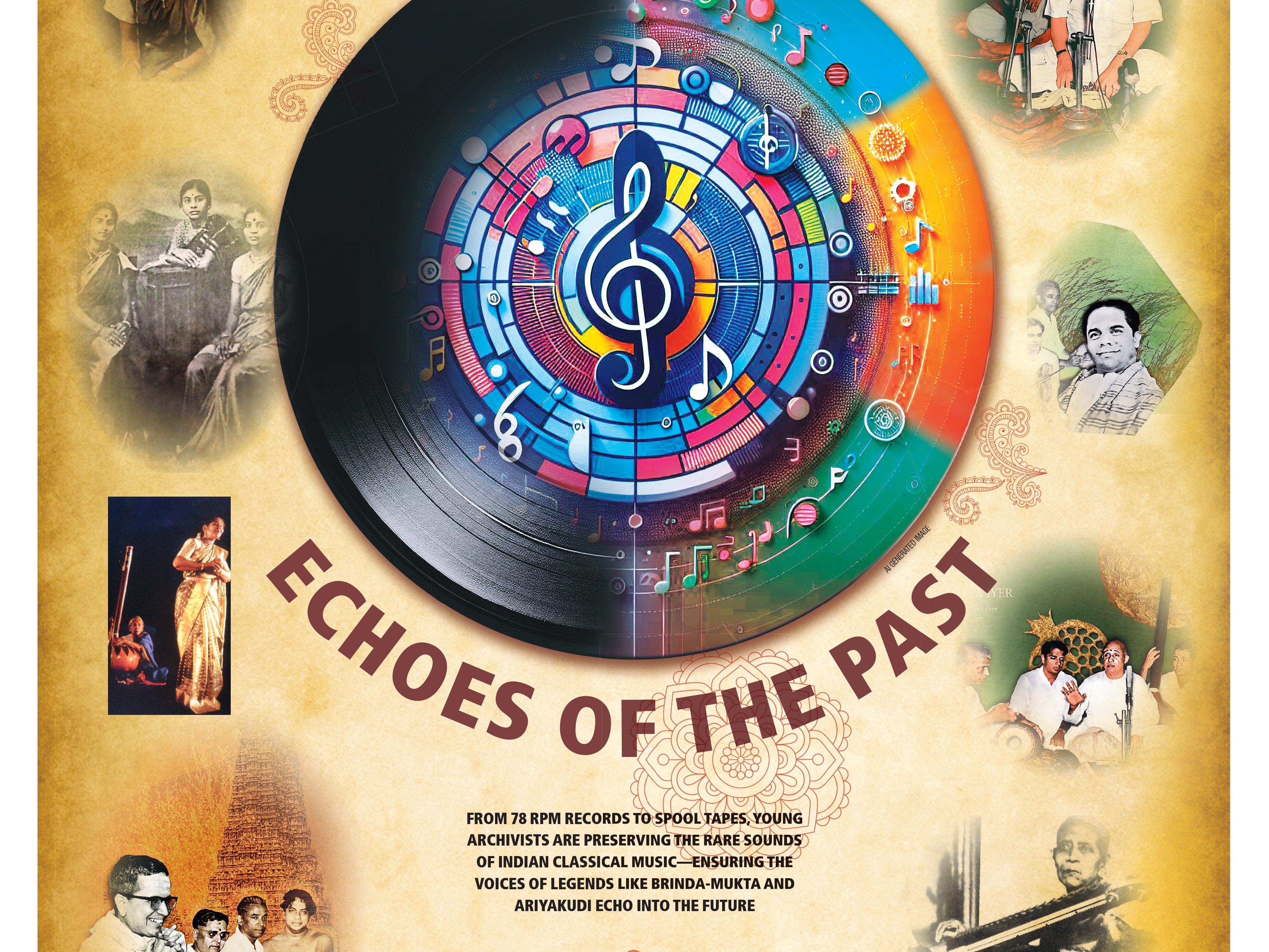
A Radio Sangeet Sammelan recording of Ariyakudi Ramanuja Iyengar plays out of a bluetooth speaker just as it must have done out of a Murphy radio set in 1957. And then you hear a veena concert of S Balachander, which he played for the Sangeet Natak Akademi, Delhi, in 1967. Very few of the rasikas who listened to these in the prime of their lives are around now but thanks to many archivists, these recordings are being rediscovered by youngsters and the old alike.
One such arts initiative is Vaak, founded by Shreeram Shankar, Vivek Ramanujan and Archana Sivasubramanian, who focus on building archives and curating arts experiences.
Shreeraam comes from a family of dancers and was exposed to the art at a very young age. While Vaak began its work in 2017, it was during the pandemic that the organisation picked up pace. Covid was at its peak when they began their Instagram page, where they shared 78 rpm recordings from the early 20th century and uploaded tracks in a chronological order.
“A lot of pre-1955 recordings were on copper wire, which was expensive and hard to maintain. We also don’t have copper wire players today so most of what we have are from the post-1955 period. Studio recordings on 78 rpm records survived, but these are not fully representative of an artist’s performance career because one needs to listen to an their concerts to gauge their style and range. A lot of copper wire recordings were converted to spool tapes, and those have survived,” says Shreeraam, who sourced these for collectors, recorders or their descendants who maintained them over the decades.
“A lot people claim their have wire recordings from the early 1950s but those would end up being from the 1960s or 70s. It’s hard to establish legitamacy of recordings – to know who is the recorder and when it was recorded. Sometimes we need to establish the date seeing who were the accompanying artistes,” says Shreeraam
Vaak has been doing a few offline listening sessions to get rasikas together. “We have attracted a lot of young rasikas and I’d say 60 per cent of our listeners are from the 25-50 age group and I feel very hopeful about the new generation of listeners, says Shreeraam, who also collects photographs of artistes.ˀ
The pandemic was also a game-chager for Sushanth Prem, a Melbourne-based accountant, who found his purpose while cleaning up the dusty tape boxes in his Chennai home, which had plenty of recordings of his great grandmother Mukta and great grand aunt Brinda, who sang together for many years. As they got the boxes out, Sushanth felt it was pointless to keep this treasure locked up in boxes. After all, the tapes would break eventually and be lost forever. Sushanth decided to digitise them to share them within the family.
“My mother Vardhini is a master archivist and had the tapes of several programmes of Brinda and Mukta. We felt this should reach the rasikas and should not just remain in the family. Shreeraam of Vaak also nudged me to start a YouTube channel and that’s how we began the channel Brinda Mukti. Also, the Veenai Dhannammal tradition of music is a niche one and more recordings had to be made available to those who loved it,” says Sushanth, who shared a mix of concert recordings, private recordings and AIR concerts on his channel. Apart from Brinda and Mukta, the channel also has recordings of artistes like T Balasaraswati, T Vishwanathan and Jayammal.
Sushanth was aided by several collectors and students of his great grandmother and grandmother, who opened up their collection to him. “I am cautious about the copyright issues that come with these recordings. Even the Music Academy has not shared its concerts online for that reason. Sometimes, I accept these tapes for my private collection but don’t upload them if the rights are not clear,” he says.
The impact of these vintage recordings has been phenomenal on young listeners. For many rasikas who grew up on contemporary artistes in the Carnatic scene, it’s been the opening up of a new world being exposed to artistes like the Alathur Brothers, Ariyakudi Ramanuja Iyengar, Chembai Vaidyanatha Bhagavathar, GNB and Brinda-Mukta. It’s also a different experience listening to artistes like MS Subbulakshmi and DK Pattammal in the prime of their career. The irony is that Brinda and Mukta have a much wider fan following today than they did in their lifetime, thanks to the availability of their recordings online. “When I see a young artiste incorporate some sangathis of my great grandmother in their singing today, I feel happy,” says Sushanth.
Collecting vintage records is a process that requires time, patience and passion. Art critic Veejay Sai believes he has one of the largest collections of recordings of vintage classical and film music in India, most of which he gathered during various research projects over the years. “From vinyls, tapes, and cassettes to CDs and MP3s files, it’s been a monumental effort to gather these. It’s amazing how music has adapted through these devices and reached us. Collecting is not as tough as cataloguing them. Even some big archives get the details wrong some times. Since I enjoy the process, I don’t get bored by the process.”
From Kishore Kumar to Kishori Amonkar, Veejay holds a wide collection of Indian classical, film, and folk music. He also has interesting stories attached to many of his records at home. “Once the late Ustad Rashid Khan had returned to his hotel after a concert and while we were chatting in his room, he took out his swarmandal and broke into an hour-long rendition of raag Purvi. He sang late into the night while I captured it all. I felt it was even better than what he sang for the concert that evening,” recollects Veejay.
Holding such a collection also helps researchers a great day, especially in a country like ours where archiving is still largely left to private initiatives. Veejay is often approached by researchers and he shares copies with them. “I am not fine with people taking it for commercial purposes but I share it liberally with people who are serious about this work. One fan of Kishore Kumar came all the way from Mumbai to my residence to get one particular version of a song I had. There are also people who try to make money out of this claiming they have a recording that nobody else has. But from my experience, let me tell you this. Nobody really can claim to have something that nobody else has. In today’s age, it is very likely there are 10 copies of that floating around somewhere.”
There are a few other recordings that Veejay holds dear. “A friend of mine once came across a 10-minute cassette recording of MS Subbulakshmi, who was asked by someone what music means to her. This recording is special because MS seldom spoke so much. There is also a private recording of GN Balasubramaniam, where he can be heard giving a short description of the composition he is about to sing in English. It has great nostalgic value. Listening to these recordings you feel the artistes are still there and are conveying something. You close your eyes and you can feel MS Subbulakshmi sitting across the drawing room and talking to you.”
This article was published in the 17th anniversary edition of The Times of India, Chennai on April 14, 2025
 Madraswallah
Leave a comment