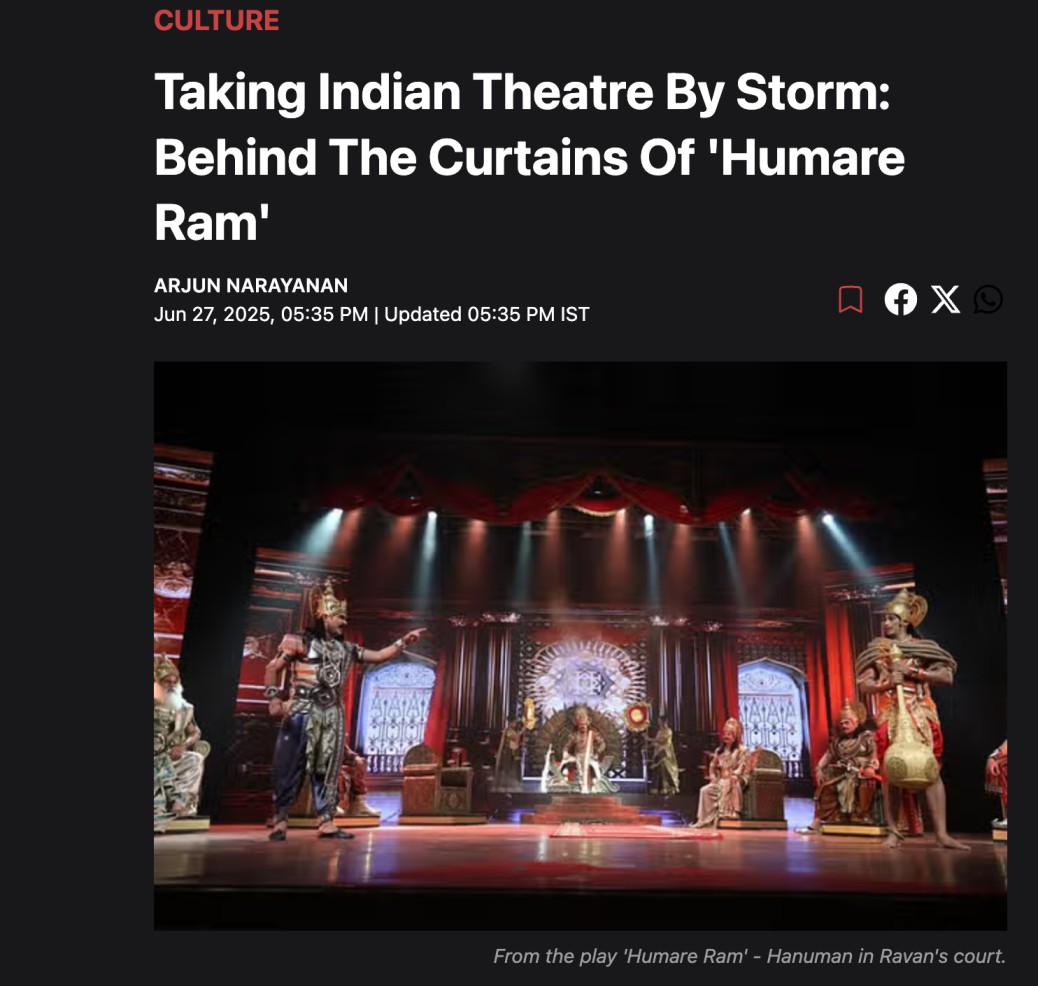
The curtains go up and one can see Rama, seated with his mothers and brothers at the yagnashala, where the ashwamedha sacrifice is on. Suddenly, two young actors emerge from the audience and sing the glory of Rama. These are Lava and Kusa, students of Valmiki, performing the Ramayana before the very hero of the epic. Felicity Theatre’s Humare Ram begins its story pretty much where Valmiki does in the Bala kanda. But then, the scene shifts to Sita’s bhumipravesh and the angry outburst of the children who have tough questions for their father, before they can let him accept them.
Humare Ram is an attempt to answer the questions that have run in the minds of sceptics for ages, which have been given utterance through the characters of Lava and Kusa. The silent witness of creation, Surya, himself appears to tell the story of Ram and explain his actions. After all, Rama offered a great benediction to Surya by being born in his very dynasty. The play has been written by Rahull Bhuchar, who has also played the role of Ram in it.
What is surprising is that in a country with a rich tradition of theatre, it’s taken so many years to stage a play on the Ramayana that has made the urban audience sit down and take notice of it. The press reviews have been nothing less than spectacular so far. While some reviews have called it a magnum opus and a grand theatrical spectacle, some have pointed out that the play has become a super hit while a big budget movie on the same theme has bombed (with obvious references to Adipurush). Several celebrities have quietly gone to watch the play over the months and heaped praise on it. Online forums like Reditt are buzzing with positive words from the viewers who have called it a great theatre experience of their lives. All these factors led me to watch the play in Chennai. While I was amazed by the grandeur mounted on stage and was moved by the portrayal, I also wanted to know more about the making of the play. I wanted to know about it all from the beginning.
The genesis
Rahull has been in the theatre scene for almost a decade-and-a-half. Many years back he had accompanied his friend and producer Bobby Malik to a press conference and was taken by surprise when he was chosen to play the role of Ram in Ayodhya ki Ramleela.
“I was always fascinated by the Ramayana. But it also disturbed me that people questioned the conduct of Rama all the time, especially with respect to the exile of Sita. I wanted to present answers to those questions. I spent two years studying over five versions of the epic, written by Valmiki, Tulsidas, Kambar and others, including the Adbhuta Ramayana and other puranas.”
“The idea was to show people something that they could think about. So around 60 per cent of the play had known elements, and in the rest, we have tried to show some lesser known stories,” says Rahull, who got the script written in a poetic style by Naresh Katyayan.
But Rahull did not cast himself initially in the role of Rama. His initial choice was Sonu Sood. Later, he went to Saurabh Raj Jain, who had played Krishna in the Star Plus Mahabharat. But things did not work out. “I then thought, why not do it myself? I had done this for Ram Leela over five times and I was devoted to Ram. But my portrayal of Rama was the same then and now. It doesn’t matter if the person is a common man coming to watch a Ram Leela or someone spending thousands on a ticket for Humare Ram. I believe they both should get the same experience of knowing Rama.”
Rama on stage
Watching the Ramayana on stage is not a new concept for an average Indian. There are differing opinions on the origin of the Ram Leela, though most of the fingers point to Varanasi as its place of origin. Some suggest that it existed even before Tulsidas wrote the Ramcharitmanas. The name of Tulsi’s disciple Megha Bhagat often comes up when it comes to the origin of Ram Leela. Legend has it that Tulsidas not only reworked the idea of Ram Leelas but his epic poem also became the guiding light for its performances across the country. Since, then, the Ramcharitmanas of Tulsi has become synonymous with the Ramayana across the northern belt, despite there being many versions predating his work.
Right across the Ganga is the town of Ramnagar and according to one legend, the prince of Ramnagar fell seriously ill and the queen took an oath to organise Ram Leela in Ramnagar, just like it happens in Varanasi. The royal family invited the great writer and father of modern Hindi literature Bharatendu Harishchandra, who wrote a new Ram Leela for Ramnagar. But even he based it on the epic poem of Tulsidas. Ramcharitmanas also gained academic appreciation from intellectuals over time. The great critic Ramchandra Shukla placed Tulsidas as the greatest medieval poet and the epic poem as a milestone of Hindi literature. While the epic had been a part of classical and folk theatre in various parts of India, when cinema came knocking at our doors, filmmakers from Dadasaheb Phalke to Vijay Bhatt turned to the Ramayana for inspiration.
In the 1980s, when the television became the new thing in town, Ramanand Sagar’s Ramayan created a storm not only in the drawing rooms but also in India’s political landscape. The great poet and academician Shivmangal Singh Suman once profusely praised Sagar at a public function, where he said that when the nation was being torn apart by secessionist forces with separatist demands, Sagar’s Ramayan unified the country like never before. He even went on to announce that four centuries after Tulsidas, it was Ramanand Sagar who ensured that the Ramayana reached the common man in his home, making Sagar a modern day legend.
For the masses, the actors who convincingly play the roles of Rama, Sita, Lakshman, Hanuman and Ravan became nothing less than demigods and for this very reason, every film-maker or theatre director takes the casting of their Ramayan very seriously.
The casting call
Rahull spent over two years convincing Ashutosh Rana for the role of Ravana. The entry of Ashutosh Rana was a game changer for the team. The play’s director Gaurav Bharadwaj calls him a sea of knowledge.
“You get actors who can do their roles well. And then you get actors like him who are also subject matter experts. Ashu ji (Ashutosh Rana) has written the Sahitya Akademi award winning book Ram Rajya. and is currently working on a book on Krishna. During its making, our discussions would go till three in the morning. He became a guide for not just me but the entire crew. He returned to theatre after a gap of over 20 years with Humare Ram and he didn’t charge a single rupee for his rehearsals and fully immersed himself in the process. After rehearsing for 8-10 hours, he would also then sit and watch others do their part and give valuable feedback. He sat down at the writing table with us, and the character of Ravan emerged differently thanks to his inputs. That’s why this Ravan moved beyond the raucous laughter that we often associate with rakshasa characters.”
Gaurav was known to Rahull for a long time. He came from an advertising background but was new to theatre. For that matter, even the epic was not fully familiar to Gaurav, who spent a lot of time studying it before taking up this project. “Rahul has been running a non-profit theatre organization to promote Indian theatre and make it commercially viable. But this play has become a milestone for us,” says Gaurav, who believes that devotion should involve surrender without any doubt about the one we worship.
“We wanted to take the questions head-on and hence began this with the ashwamedha yagna of Rama and the questions about Sita’s exile. Very often, we heard that after Ramanand Sagar’s Ramayan, nothing has done justice to the epic but we didn’t let that weigh us down. In today’s world, numbers speak volumes and our ticket sales have been tremendous. The front row tickets are charged at Rs 15,000 and there are people who have watched it over 10 times so far. We have done 235 shows by now. Our venues are booked till December 2026 and we are taking this to the US next year,” says Gaurav.
Deep Engagement
At 3 hours and 15 minutes, it might seem like an impossible task at a time when even a 15 second Instagram reel fails to hold the attention of people. But being from an advertising background, Gaurav knows the game of attention.
“Every scene has been timed accurately, and every step that an artiste takes is rehearsed. In fact, despite its length, even kids are enjoying this thoroughly across cities. We even ensured that the language was poetic but not challenging for the contemporary audience. But a lot happens on stage spontaneously. After all, theatre is an actor’s medium. Every time, Ashu ji does the Lakshman samvaad in the end, he brings in something different. When Sita’s bhumipravesh happens, I see Rahull undergo something inexplicable and in every show and he breaks down. Those are moments that just happen on stage.”
Rahull has left no stone unturned for the play, be it in set design, costumes or music. The whole play was rehearsed for over eight months before it was staged for the first time and Rahull was particular about fine aspects, right up to the pause taken during the dialogue delivery. The costumes have been done by Vishnu Patil, who had also provided costumes for Ramanand Sagar’s Ramayan and BR Chopra’s Mahabharat. Singers like Sonu Nigam, Shankar Mahadevan and Kailash Kher were roped in and Ashutosh Rana himself sang the Shiva Tandava stotram in Hindi. “It’s important to surrender to the divine when you undertake such tasks. Think of Ravan, who offered his head and the ego that comes with it to Shiva. The same quality of surrender is required when you approach subjects like these. The success or failure eventually depends on the audience, but we have done this with the best intention.”
Another point where Humare Ram stands strong is that it doesn’t unnecessarily play to the gallery, a case in point being the the portrayal of Soorpanakha. In several modern retellings of the epic, Soorpanakha is projected a victim of misogyny, while Ravana’s act of abducting Sita is shown simply as an act of revenge by a brother. They even go on to commend him for not violating Sita. But Rahull has stuck to the works of the saint poets like Valmiki and Kambar. In fact, he uses an interesting story from the Kamba Ramayana to show the back story of Soorpanakha in the epic, which makes for an interesting insight and a galvanising act by Deepti Kumar. And you also get to know why Ravana chose not to violate Sita with the episode of Rambha and Nalkubera.
Sita’s role has been played by Harleen Rekhi, who is also currently essaying the character of Mandodari in the series Kakbhushundi Ramayan by Sagar Arts, that’s being aired on DD National. Danish Akhtar as Hanuman and Tarun Khanna as Shiva have also proven their mettle in these roles on television in the past. The actors of Humarae Ram comfortably redefine the concept of space through the play. Sometimes, they step down the stage and walk amid the audience during a long monologue, and sometimes, they dramatically emerge from the rear entrance of the hall. The production quality surpasses what we have seen on the Indian stage in a long time.
Playing a character so divine has never been easy on actors who have been lauded by the masses for their portrayal. In India, actors who play gods become no less than gods in the public eye. In the 1940s, it was Prem Adib and Shobana Samarth rising to godhood with Vijay Bhatt classics like Bharat Milap (1942) and Ram Rajya (1943). Briefly in the 1960s, Mahipal and Anita Guha had their tryst with divine glory post the success of Sampurna Ramayan (1961). In our own time, Arun Govil and Dipika Chikhlia lived the roles of Ram and Sita on-screen and have also had to live up to the role off-screen. To this day, the halo of Ram and Sita have refused to leave Arun Govil and Dipika.
Harleen Rekhi feels she’s been lucky to play Sita but does not feel the pressure that comes with it. “There is a dignity about playing a character like Sita and you need to maintain that maryada even off screen. I have always been spiritual as a person and dreamt of playing Sita. I guess dreams do come true,” says Harleen, who has been active in the theatre scene for over 15 years.
The theatre background has helped Harleen with Humare Ram as well and as she dons on the makeup and walks up to stage to live the role of Sita yet again, she feels she’s getting closer to the character with each show. “Both Ram and Sita lived their lives within the boundary of maryada and it requires a lot of discipline and patience to not let go of that. We need these qualities today more than ever before. I have played Mandodari on the TV show Shrimad Ramayan and now on Kakbushundi Ramayan. Both these women have been venerated in our country. Manodari is among the panch kanyas. Both Sita and Mandodari tried to drill sense into Ravan and had a clear conscience. Also, I share a few scenes with Ashutosh ji as well has been a learning experience. He is a much experienced actor but once on stage, we become the character. There he is Ravan and I am Sita.”
Music can make or break a period drama. In a country where there is a rich musical tradition of Rama bhakti, a lot of effort goes into elevating the moments with songs and background music. The songs composed by Udbhav Ojha and Saurabh Mehta sometimes enhance a given emotion and sometimes play a role in taking the script forward as in a good musical. While comparisons with the past masters might seem inevitable, Saurabh chose not to listen to works on this subject as he wanted to create his own trajectory. “For me, music is bhakti and I believe the composer is only a tool. Music is nirakar brahman and it manifests through a musician,” says Saurabh.
Saurabh grew up in Ujjain, and the reading of Ramcharitmanas was a daily practice in his home. “While I don’t have any formal training in music. I composed several jingles, where you have to express the whole content in 10 seconds. It has to catch on and be hummable. While working on this play, I had it in my mind that the songs had to be hummable. And I think we have succeeded with that.”
Walking on a tight rope
Humare Ram breaks from the traditional stage depictions of the Ramayana by including the Uttara Kanda (the post coronation story of Ram and Sita, which contains portions of her second exile) in the story. It begins its journey with a resolve to answer some controversial aspects of the epic, mainly from the Uttara Kanda. But many scholars in the past have deemed the Uttara Kanda an appendix added at a later date. If poets like Tulsidas and Kambar did not write about Sita’s exile, Telugu poet Vaasudaasa Swamy believed it was a part of the epic. The narrations of the Ramayana found in the Mahabharata do not have any mention of Uttara Kanda nor is it found in the summary of the story narrated by Narada to Valmiki. Contemporary scholars like Dr Rangan have also dismissed the possibility of Uttara Kanda being a part of Valmiki’s epic. In a series of conversations, he has listed out several valid reasons as to why this appendix seems to be a later addition. Swami Ramabhadracharya of the Ramananda Sampradaya even wrote a book titled Sita Nirvasan Nahi, where he refutes the authenticity of Sita’s banishment. But the question still remains mainly because there are scholars and acharyas who believe the Ramayana is complete only with the Uttara Kanda.
But my main issue comes not with the inclusion of this episode in the play but with not fully closing the ends. While Humare Ram establishes the greatness of Rama and Sita without doubt, it still skirts some of the main questions. This does not take away the brilliance of the epic though, and that is where the play scores high. By the end of Humare Ram, you realise that the actions and decisions of characters like Rama and Sita cannot be gauged from mere human lens. It also takes down the long-standing intellectual skulduggery of quoting the controversial portions out of context without understanding the epic and in doing this, the play stands tall.
For each show, before the curtains go up, the team offers prayers to Rama backstage so that their collective endeavour is blessed. Rahull has spent over five years with the character, having done Ayodhya ki Ramleel from the days of the pandemic and every weekend, as the curtains go up, he transforms into the paragon of ideals on stage. “I feel I have changed as a person and have begun traversing a different path in life. I can see empathy grow in me as I have continued living with the character of Ram and emotions like anger and jealousy have died down. My dietary habits have changed, and I am fully a vegetarian now. Spirituality has become an important part of my life and as we have been doing this weekend after weekend, I feel connected to Ram all the time.
 Madraswallah
Leave a comment